Mary Berry Trifle Recipe
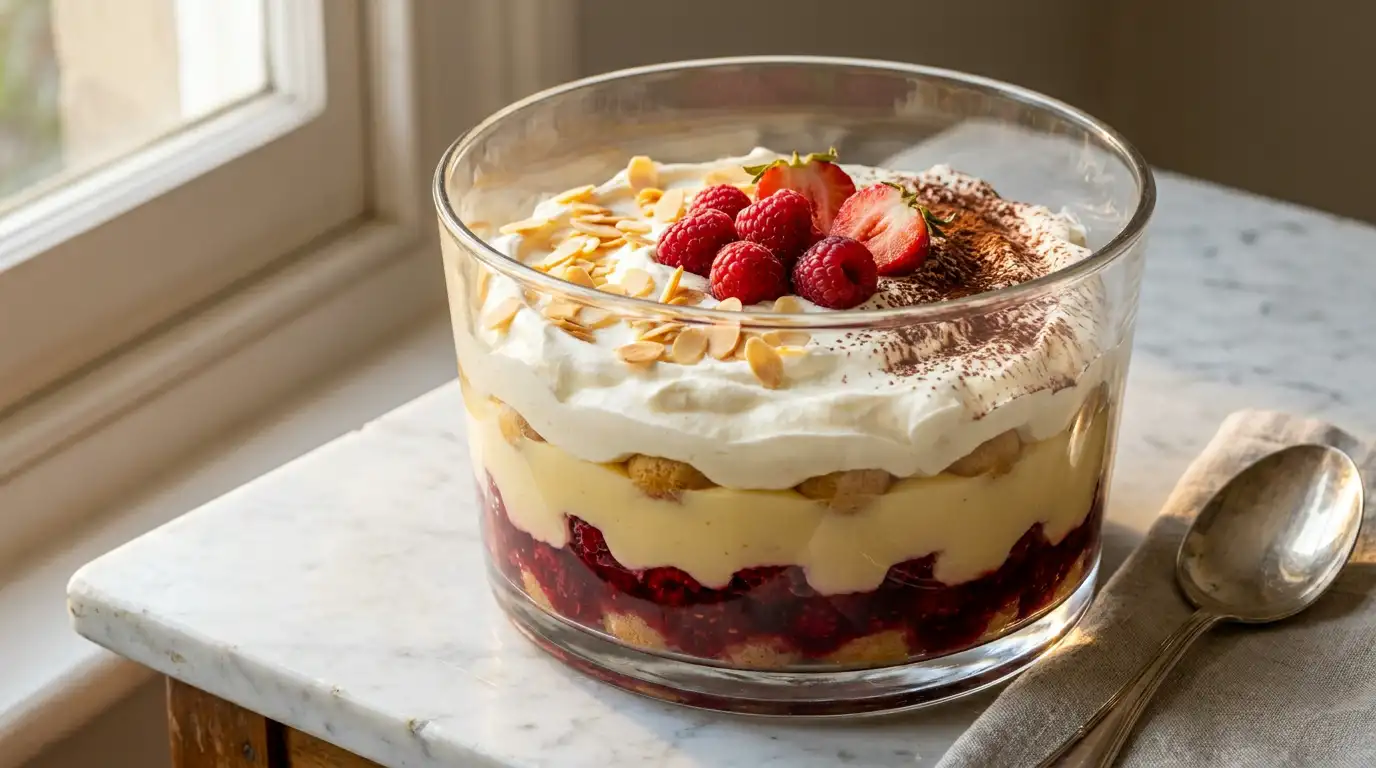
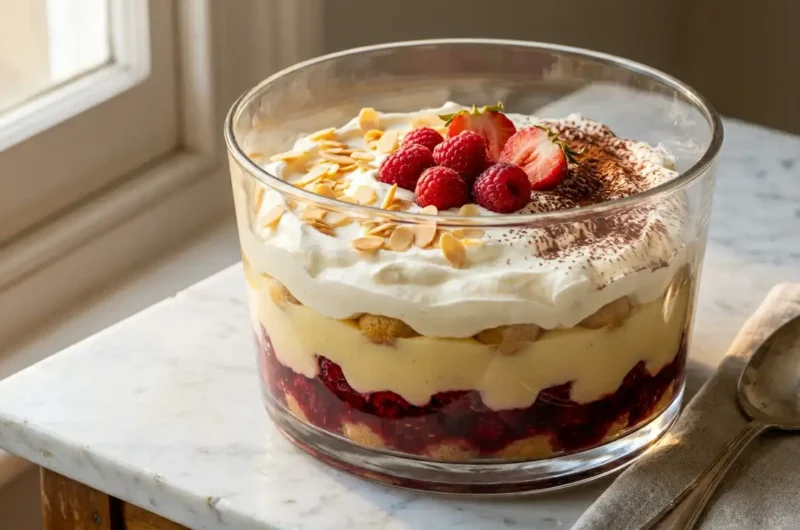
This Mary Berry trifle recipe delivers a proper layered pudding with soft sponge soaked in sherry, a thick vanilla custard, a cloud of lightly whipped double cream, and a scattering of toasted flaked almonds across the top. Each layer holds its shape, yet yields into the next when spooned into a glass bowl. It is a dessert that fills the room with the warm scent of vanilla and sweet fruit.
What sets this version apart is the balance between components. The custard is made from scratch, so it sets with a silky, pourable consistency rather than the stiff texture of a packet mix. The whole thing comes together without stress, making it equally suited to a casual Sunday lunch or a proper Christmas table. From start to finish, it is ready in around 2 hours, including chilling time.
Ingredients
For the sponge base
- 6 trifle sponge fingers
- 3 tablespoons medium-dry sherry
- 250g strawberry or raspberry jam
- 300g fresh or frozen raspberries, defrosted if frozen
For the custard
- 500ml whole milk
- 4 large egg yolks
- 50g caster sugar
- 2 tablespoons cornflour
- 1 teaspoon vanilla extract
For the cream topping
- 300ml double cream
- 1 tablespoon icing sugar, sifted
- 1 teaspoon vanilla extract
To finish
- 25g flaked almonds, lightly toasted
- A small handful of fresh raspberries or halved strawberries
- A light dusting of cocoa powder or grated dark chocolate (optional)
How to Make Mary Berry Trifle Recipe
- Prepare the sponge layer: Break the trifle sponge fingers into rough pieces and arrange them in an even layer across the base of a large glass bowl, approximately 2 litres in capacity. Spoon the sherry evenly over the sponge and leave for 5 minutes so the liquid is absorbed and the sponge softens throughout.
- Add the fruit: Warm the jam gently in a small saucepan over a low heat until it loosens to a runny consistency, then spoon it over the soaked sponge. Scatter the raspberries across the top in an even layer, pressing them down lightly so they nestle into the jam rather than sitting loosely on the surface.
- Make the custard base: Pour the milk into a medium saucepan and heat it over a medium flame until it begins to steam and small bubbles appear around the edges, stopping just before it reaches a full boil. In a heatproof bowl, whisk the egg yolks, caster sugar, cornflour, and vanilla extract together until the mixture is pale and slightly thickened, which takes around 2 minutes of brisk whisking.
- Cook the custard: Pour the hot milk slowly into the egg yolk mixture in a steady stream, whisking continuously as you go, this prevents the eggs from scrambling when the heat hits them. Return the entire mixture to the saucepan and cook over a low to medium heat, stirring constantly with a wooden spoon or silicone spatula, until the custard thickens enough to coat the back of the spoon. This takes around 8 to 10 minutes.
- Cool and pour: Remove the custard from the heat and pour it straight through a fine sieve directly over the fruit layer in the bowl. Smooth the surface with the back of a spoon, then press a sheet of clingfilm directly onto the custard surface to prevent a skin from forming. Leave to cool to room temperature, then refrigerate for at least 1 hour until fully set and cold.
- Whip the cream: Pour the double cream, icing sugar, and vanilla extract into a large mixing bowl. Whip with an electric hand whisk on a medium speed until the cream holds soft peaks, which means it just holds its shape when the whisk is lifted but still has a gentle droop at the tip. Do not over-whip, as the cream will turn grainy.
- Assemble and chill: Spoon the whipped cream over the set custard and spread it into a smooth, even layer using a palette knife or the back of a large spoon. Scatter the toasted flaked almonds evenly across the cream, then arrange the fresh berries on top. If using chocolate or cocoa, dust lightly over the finished surface. Refrigerate for a further 30 minutes before serving so all the layers firm up together.
Tips for the Best Mary Berry Trifle Recipe
Why has my custard turned lumpy instead of smooth?
Lumps form when the egg mixture is added to milk that is too hot, or when the custard cooks too quickly over a high heat. Always add the hot milk gradually while whisking, and keep the heat at low to medium once the mixture returns to the pan. Straining through a fine sieve before pouring over the trifle catches any small lumps that do form.
Why is my custard not setting firm enough after chilling?
A loose custard usually means it was not cooked long enough. The mixture needs to reach a temperature where the cornflour activates fully, around 82 to 84 degrees Celsius. Cook until the custard visibly thickens and coats the back of a spoon without running off immediately. If in doubt, give it an extra 2 minutes on the heat, stirring continuously.
How do I stop the cream layer from weeping or going watery?
Cream releases liquid when it is over-whipped or when it sits on a warm custard layer. Always make sure the custard is fully cold before adding the cream, and whip only to soft peaks rather than stiff peaks. Soft peaks hold their shape in the bowl without collapsing, but remain stable over time in the fridge.
Why does my trifle look messy when I serve it rather than showing clean layers?
This happens when the trifle has not had enough chilling time between each layer. The custard must be fully set before the cream is added, and the assembled trifle needs at least 30 minutes in the fridge before it is spooned out. Using a straight-sided glass bowl also helps keep each layer visually distinct from the outside.
Why is the sponge base soggy and falling apart rather than soft and moist?
A completely dissolved base usually means too much liquid was added. Three tablespoons of sherry is enough to moisten the sponge without flooding it. If sherry is being omitted, replace with a small amount of fruit juice, but apply it sparingly, the sponge should be damp and soft, not waterlogged.
Serving Suggestions
- Spoon into individual glass dishes at the table so each guest can see the distinct layers of sponge, fruit, custard, and cream.
- Serve alongside a plate of thin butter biscuits or shortbread fingers for a contrast in texture.
- Offer extra lightly whipped double cream on the side for guests who prefer a richer portion.
- Pair with a small glass of chilled dessert wine or elderflower cordial for a summer lunch setting.
- Place the bowl in the centre of the table for a celebratory occasion, the layers of cream and fruit make it a striking centrepiece pudding.
Storage
Room temperature
The assembled trifle should not be left at room temperature for more than 1 hour due to the dairy-based custard and cream layers.
Refrigerator
Cover the surface of the trifle with clingfilm and refrigerate for up to 2 days. For the freshest cream texture, add the whipped cream topping on the day of serving if preparing ahead. Remove from the fridge around 15 minutes before serving so the custard layer softens slightly.
Freezing
This trifle is not suitable for freezing once fully assembled, as the custard separates and the cream breaks down on defrosting. The sponge and fruit layers alone can be frozen for up to 1 month, tightly covered, then defrosted overnight in the fridge before the custard and cream are added fresh.
Nutrition
- Calories: 420 kcal
- Carbohydrates: 38g
- Protein: 7g
- Fat: 26g
- Saturated Fat: 15g
- Sodium: 95mg
Nutrition values are estimates and may vary depending on the specific ingredients and brands used, as well as the portion size served.
FAQs
Can I make this trifle without sherry?
Yes. Replace the sherry with the same quantity of fresh orange juice, apple juice, or a small amount of elderflower cordial diluted with water. The sponge still soaks up the liquid and softens in the same way, though the flavour will be lighter and more fruit-forward.
Can I use ready-made custard instead of making it from scratch?
Ready-made fresh custard from the chilled aisle works well here as a time-saving option. Choose a good-quality pourable custard rather than the tinned variety, and allow it to cool before layering so it does not melt the fruit below. Avoid instant granule custard, as the texture tends to be thicker and less silky.
Can this trifle be made the day before?
Yes, and it actually benefits from being made a day ahead. The layers meld together overnight, the custard firms up fully, and the sponge absorbs the sherry more deeply. Add the whipped cream and decorations on the morning of serving to keep the top looking fresh and cloud-like.
What size bowl works best for this recipe?
A round glass bowl with a capacity of around 2 to 2.5 litres works well for this quantity. A glass bowl is traditional because the layers are visible from the outside. A straight-sided bowl shows the layers most clearly, though any deep, wide bowl will work perfectly well for serving.
Can I use a different fruit instead of raspberries?
Yes. Strawberries, tinned peach slices, or a mixture of summer fruits all work well in place of raspberries. Choose a jam that matches the fruit you use, so strawberry jam with strawberries, or apricot jam with peaches, to keep the flavour consistent through the layers.
Conclusion
This Mary Berry trifle recipe is a layered British classic that holds together beautifully whether served at Christmas dinner, a summer garden party, or a simple family Sunday lunch. The scratch-made custard gives it a depth of flavour that sets it apart from a quick assembled version, and the contrast between the sherry-soaked sponge, cold fruit, creamy custard, and soft whipped cream makes every spoonful satisfying. This recipe serves 6 to 8 people generously from a standard 2-litre bowl.
If this is a recipe to return to again and again, it is worth keeping the technique for the custard in mind as a base for other desserts too. Share this recipe with someone who needs a reliable, crowd-pleasing pudding for their next occasion. If you enjoyed this, you might also like the Mary Berry Lemon Yoghurt Cake Recipe, another straightforward classic with a bright, refreshing finish.
Mary Berry Trifle Recipe
Course: DessertCuisine: BritishDifficulty: Easy8
servings30
minutes20
minutes420
kcal2
hoursA classic British layered pudding with sherry-soaked sponge, fresh raspberries, silky homemade vanilla custard, and lightly whipped double cream, finished with toasted flaked almonds and fresh berries.
Ingredients
6 trifle sponge fingers
3 tablespoons medium-dry sherry
250g strawberry or raspberry jam
300g fresh or frozen raspberries, defrosted if frozen
500ml whole milk
4 large egg yolks
50g caster sugar
2 tablespoons cornflour
1 teaspoon vanilla extract
300ml double cream
1 tablespoon icing sugar, sifted
1 teaspoon vanilla extract
25g flaked almonds, lightly toasted
a small handful of fresh raspberries or halved strawberries
a light dusting of cocoa powder or grated dark chocolate, optional
Instructions
- Break the trifle sponge fingers into rough pieces and arrange in an even layer across the base of a large 2-litre glass bowl. Spoon the sherry evenly over the sponge and leave for 5 minutes to absorb.
- Warm the jam in a small saucepan over a low heat until it loosens, then spoon over the soaked sponge. Scatter the raspberries across the top and press down lightly so they nestle into the jam.
- Pour the milk into a medium saucepan and heat until steaming. In a heatproof bowl, whisk egg yolks, caster sugar, cornflour, and vanilla extract until pale and slightly thickened.
- Pour the hot milk slowly into the egg mixture in a steady stream, whisking continuously. Return to the pan and cook over a low to medium heat, stirring constantly, until the custard thickens and coats the back of a spoon, around 8 to 10 minutes.
- Pour the custard through a fine sieve directly over the fruit layer. Smooth the surface, press clingfilm onto the custard to prevent a skin, and leave to cool before refrigerating for at least 1 hour.
- Whip the double cream, icing sugar, and vanilla extract to soft peaks using an electric hand whisk on medium speed.
- Spoon the whipped cream over the set custard and spread into an even layer. Scatter toasted flaked almonds and fresh berries on top, dust with cocoa if using, and refrigerate for a further 30 minutes before serving.
Notes
- Add hot milk gradually to the egg mixture while whisking to prevent scrambling.
- Strain the custard through a fine sieve before pouring to catch any lumps.
- Press clingfilm directly onto the custard surface while cooling to prevent a skin from forming.
- Always ensure the custard is fully cold before adding the whipped cream layer.
- Whip cream only to soft peaks to keep the topping stable during chilling.
- The trifle can be made a day ahead, add the cream and decorations on the day of serving.
- Replace sherry with orange juice or elderflower cordial for a non-alcoholic version.