Mary Berry Blackcurrant Jam Recipe
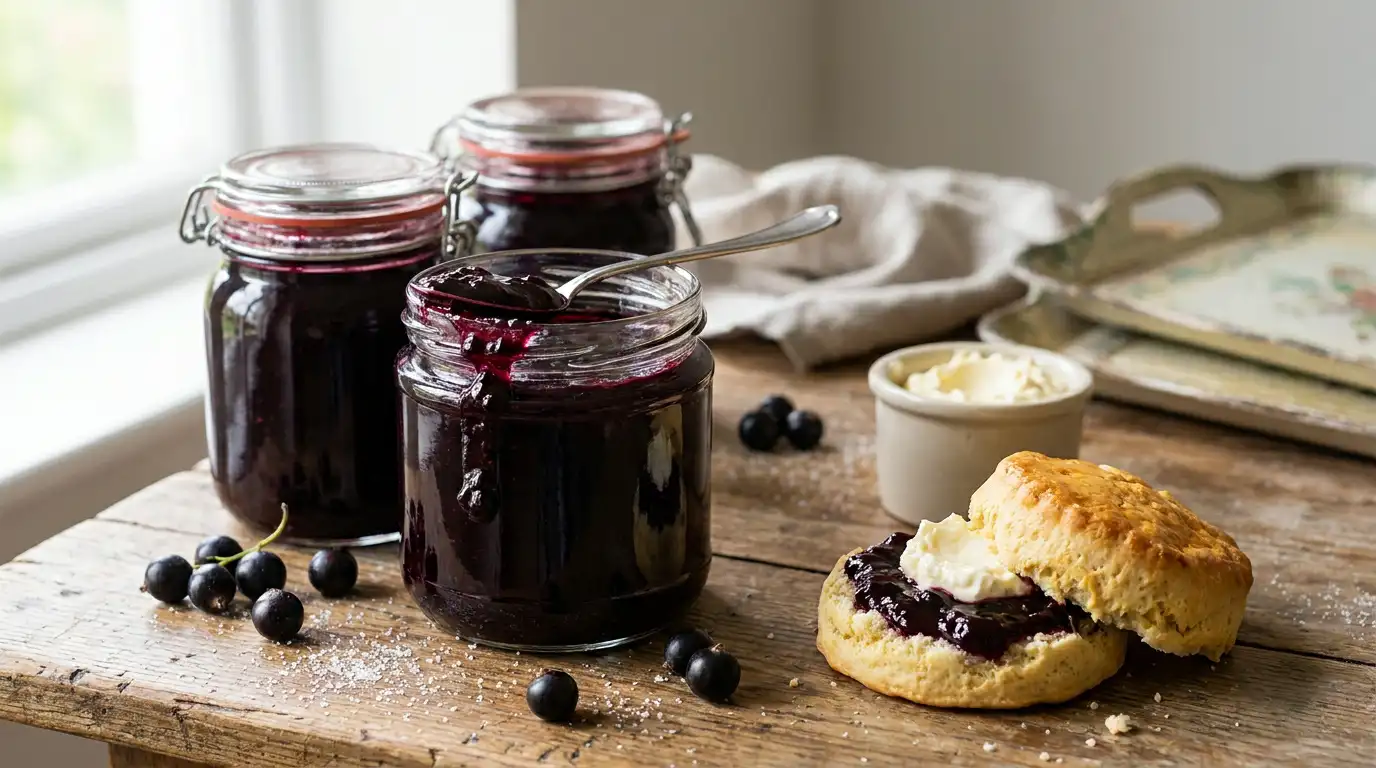
Mary Berry blackcurrant jam is a deeply coloured, intensely fruity preserve with a firm set and a glossy finish that spreads cleanly across warm toast or a freshly baked scone. The flavour is bold and slightly tart, with that distinctive blackcurrant depth that softens just enough as the sugar works through the fruit during cooking. This recipe uses straightforward timing and a reliable method that produces consistent results even for first-time jam makers. It suits a quiet weekend morning and fills three to four standard jars. From start to finish, it is ready in around 1 hour.
What makes this version particularly reliable is the natural pectin content of blackcurrants, which means the jam sets firmly without any added pectin. The ratio of fruit to sugar is balanced carefully to give a preserve that is neither too sharp nor cloying. It works beautifully as a filling for Victoria sponge, as a topping for rice pudding, or simply stirred into plain yoghurt.
Ingredients
For the jam
- 900g fresh or frozen blackcurrants, stalks removed
- 300ml water
- 900g granulated sugar or jam sugar
- 1 tsp unsalted butter (optional, to reduce surface foam)
How to Make Mary Berry Blackcurrant Jam Recipe
- Prepare the jars: Wash three to four 450ml glass jars and their lids in hot soapy water, rinse well, then place upright on a baking tray in an oven set to 120C (100C fan) for at least 20 minutes. Leave in the oven until the jam is ready to pot, as the jars must be hot when filled to prevent cracking and to aid the seal.
- Soften the fruit: Place the blackcurrants and water into a large, heavy-based saucepan or preserving pan. Bring to a gentle simmer over a medium-low heat and cook for 15 to 20 minutes, stirring occasionally, until the skins are fully softened and the fruit has broken down into a deep purple pulp. This stage is essential because under-softened skins will not break down further once the sugar is added.
- Add the sugar: Pour in all of the granulated sugar at once and stir over a low heat until every grain has dissolved completely before turning up the heat. Run a spoon across the bottom of the pan to check there is no grittiness remaining, as undissolved sugar can cause the jam to crystallise during storage.
- Bring to a rolling boil: Once the sugar has fully dissolved, increase the heat to high and bring the jam to a rapid, rolling boil. A rolling boil cannot be stirred down and produces a vigorous, bubbling surface across the whole pan. Boil hard for 8 to 10 minutes without stirring.
- Test the set: After 8 minutes, place a small amount of jam onto a cold saucer that has been sitting in the freezer. Leave it for 30 seconds, then push the surface gently with your fingertip. If it wrinkles and holds its shape, the jam has reached setting point. If it runs back together, boil for a further 2 minutes and test again.
- Skim and add butter: Remove the pan from the heat. If a foam has formed on the surface, add the teaspoon of butter and stir gently. The foam will dissipate within a minute or two, leaving a cleaner surface on the finished jam.
- Pot the jam: Leave the jam to settle for 5 minutes, then ladle carefully into the hot sterilised jars using a jam funnel if you have one. Fill each jar to within 5mm of the rim. Seal immediately with the lids and leave undisturbed to cool completely on a wire rack or folded tea towel.
- Label and store: Once the jars are fully cold, check that each lid has formed a vacuum seal by pressing the centre gently. It should not flex up and down. Label with the date and store in a cool, dark place.
Tips for the Best Mary Berry Blackcurrant Jam Recipe
Why has my blackcurrant jam not set even after reaching setting point on the saucer test?
The saucer test is the most reliable guide, but the jam must be truly at a rolling boil for the full recommended time before testing. If the boil was moderate rather than vigorous, the jam will need a further 3 to 5 minutes at a harder boil. Return the pan to the heat, bring back to a full rolling boil, then test again on a fresh cold saucer.
Why has my jam turned out too firm and stiff once cooled?
Blackcurrants are naturally very high in pectin, which means the jam can set harder than expected if boiled for too long past setting point. Always start testing at the 8-minute mark and stop boiling as soon as the wrinkle test passes. Over-setting is difficult to reverse once the jam has cooled in the jar.
Why does my jam have a lot of foam on the surface even after adding butter?
Foam forms during the boil from air trapped in the fruit pulp. The butter helps to break the surface tension, but you may still need to skim gently with a metal spoon. Leaving the jam to settle for 5 minutes off the heat before potting also gives the foam time to clear naturally.
Why is there a layer of syrup at the bottom of my cooled jar with the fruit sitting on top?
This happens when the fruit was not fully softened before the sugar was added, or when the jam was not left to rest for 5 minutes before potting. The brief resting period allows the fruit solids to distribute evenly through the setting gel. Stir the jam gently within the jar while it is still slightly warm to redistribute the fruit if needed.
Why has my jam crystallised in the jar after a few weeks?
Crystallisation occurs when sugar is added before the fruit skins have softened fully, or when the sugar did not dissolve completely before the temperature was raised. Always ensure there is no gritty texture at the base of the pan before increasing the heat, and soften the fruit thoroughly in the first stage of cooking.
Serving Suggestions
- Spread generously over a warm, buttered scone alongside clotted cream for a classic afternoon tea pairing.
- Use as a filling between the sponge layers of a Victoria sandwich, spread directly onto the bottom layer before adding whipped cream on top.
- Swirl a spoonful through warm, creamy porridge in the morning for a sharp, fruity contrast to the oats.
- Serve alongside a thick slice of sharp Cheddar on a cheeseboard, where the tartness of the blackcurrant cuts through the richness of the cheese.
- Stir into plain Greek yoghurt and top with granola for a simple, flavourful breakfast.
Storage
Room Temperature
Store sealed, unopened jars in a cool, dark cupboard for up to 12 months.
Refrigerator
Once a jar has been opened, keep it in the refrigerator and use within 6 to 8 weeks. Bring the jar to room temperature for around 10 minutes before serving if a softer, more spreadable consistency is preferred.
Freezing
Blackcurrant jam can be frozen in freezer-safe containers with a 1cm headspace to allow for expansion, and will keep well for up to 12 months. Defrost overnight in the refrigerator and use within 4 weeks of thawing.
Nutrition
- Calories: 45 kcal
- Carbohydrates: 11g
- Protein: 0.1g
- Fat: 0.1g
- Saturated Fat: 0g
- Sodium: 1mg
Nutrition values are estimates per tablespoon serving and may vary depending on the specific ingredients used and the final yield of the batch.
FAQs
Can I use frozen blackcurrants instead of fresh for this jam?
Yes, frozen blackcurrants work very well and are often easier to find outside of the short summer season. Use them straight from frozen and add them directly to the pan with the water. They will release extra liquid as they thaw during cooking, so allow a few extra minutes for the fruit to soften fully before adding the sugar.
Can I use jam sugar instead of granulated sugar in this recipe?
Jam sugar contains added pectin, which will produce a very firm set when combined with the already pectin-rich blackcurrants. Granulated sugar is recommended for this recipe as it gives a firm but nicely spreadable result. If jam sugar is all that is available, reduce the boiling time slightly and test the set earlier, around the 6-minute mark.
Can I make this recipe with a mix of blackcurrants and redcurrants?
A mix of blackcurrants and redcurrants works well and produces a slightly lighter coloured jam with a more delicate flavour. Use up to half redcurrants in place of blackcurrants, keeping the total fruit weight the same. The method and sugar quantity remain unchanged.
Can I halve this recipe to make a smaller batch?
The recipe halves easily. Use 450g blackcurrants, 150ml water, and 450g sugar, and follow the same method. The boiling time may be slightly shorter as there is less volume in the pan, so begin testing for a set at the 6-minute mark rather than 8.
Is this jam suitable for vegetarians and vegans?
The jam is suitable for vegetarians. For a vegan version, simply leave out the optional teaspoon of butter used to reduce surface foam. The jam will still set correctly without it, though you may need to skim a little more foam from the surface using a metal spoon.
Conclusion
This Mary Berry blackcurrant jam recipe delivers a firm, deeply coloured preserve with a bright, natural flavour that holds up beautifully across months of storage. The method is straightforward and relies on the fruit’s own pectin content to achieve a reliable set without specialist ingredients. Made with 900g of blackcurrants and 900g of sugar, this batch yields three to four 450ml jars, which is a practical amount for home use and makes a thoughtful gift for family or friends.
Whether spread across freshly baked scones, layered into a Victoria sandwich, or used to lift a simple bowl of porridge, a well-made blackcurrant jam is one of the most versatile preserves to have in the cupboard. If this recipe inspired you to explore more classic baking, you might also enjoy the Mary Berry courgette cake recipe, which uses a similar straightforward approach to produce something reliably impressive.
Mary Berry Blackcurrant Jam Recipe
Course: PreservesCuisine: BritishDifficulty: Easy4
servings10
minutes50
minutes45
kcal1
hourA deeply coloured, intensely fruity blackcurrant jam with a firm set and glossy finish. Made with just four ingredients, this beginner-friendly preserve is bold, slightly tart, and perfect for spreading on scones, filling sponge cakes, or gifting in jars.
Ingredients
900g fresh or frozen blackcurrants, stalks removed
300ml water
900g granulated sugar or jam sugar
1 tsp unsalted butter (optional, to reduce surface foam)
Instructions
- Wash three to four 450ml glass jars and their lids in hot soapy water, rinse well, then place upright on a baking tray in an oven set to 120C (100C fan) for at least 20 minutes. Leave in the oven until the jam is ready to pot.
- Place the blackcurrants and water into a large, heavy-based saucepan or preserving pan. Bring to a gentle simmer over a medium-low heat and cook for 15 to 20 minutes, stirring occasionally, until the skins are fully softened and the fruit has broken down into a deep purple pulp.
- Pour in all of the granulated sugar at once and stir over a low heat until every grain has dissolved completely before turning up the heat. Run a spoon across the bottom of the pan to check there is no grittiness remaining.
- Once the sugar has fully dissolved, increase the heat to high and bring the jam to a rapid, rolling boil. Boil hard for 8 to 10 minutes without stirring.
- After 8 minutes, place a small amount of jam onto a cold saucer that has been sitting in the freezer. Leave it for 30 seconds, then push the surface gently with your fingertip. If it wrinkles and holds its shape, the jam has reached setting point. If it runs back together, boil for a further 2 minutes and test again.
- Remove the pan from the heat. If a foam has formed on the surface, add the teaspoon of butter and stir gently. The foam will dissipate within a minute or two.
- Leave the jam to settle for 5 minutes, then ladle carefully into the hot sterilised jars using a jam funnel if you have one. Fill each jar to within 5mm of the rim. Seal immediately with the lids and leave undisturbed to cool completely.
- Once the jars are fully cold, check that each lid has formed a vacuum seal by pressing the centre gently. Label with the date and store in a cool, dark place.
Notes
- Always soften the blackcurrant skins fully before adding sugar, as they will not break down further once the sugar is in the pan.
- Do not add sugar until all grittiness has gone from the base of the pan to prevent crystallisation during storage.
- Begin testing for a set at the 8-minute mark to avoid over-setting, which is difficult to reverse once the jam has cooled.
- Leave the jam to rest for 5 minutes off the heat before potting to help the fruit distribute evenly through the gel.
- Use frozen blackcurrants straight from frozen if fresh are unavailable, and allow a few extra minutes for softening.
- Omit the butter to keep the recipe fully vegan, and skim surface foam with a metal spoon instead.