Mary Berry Profiteroles Recipe
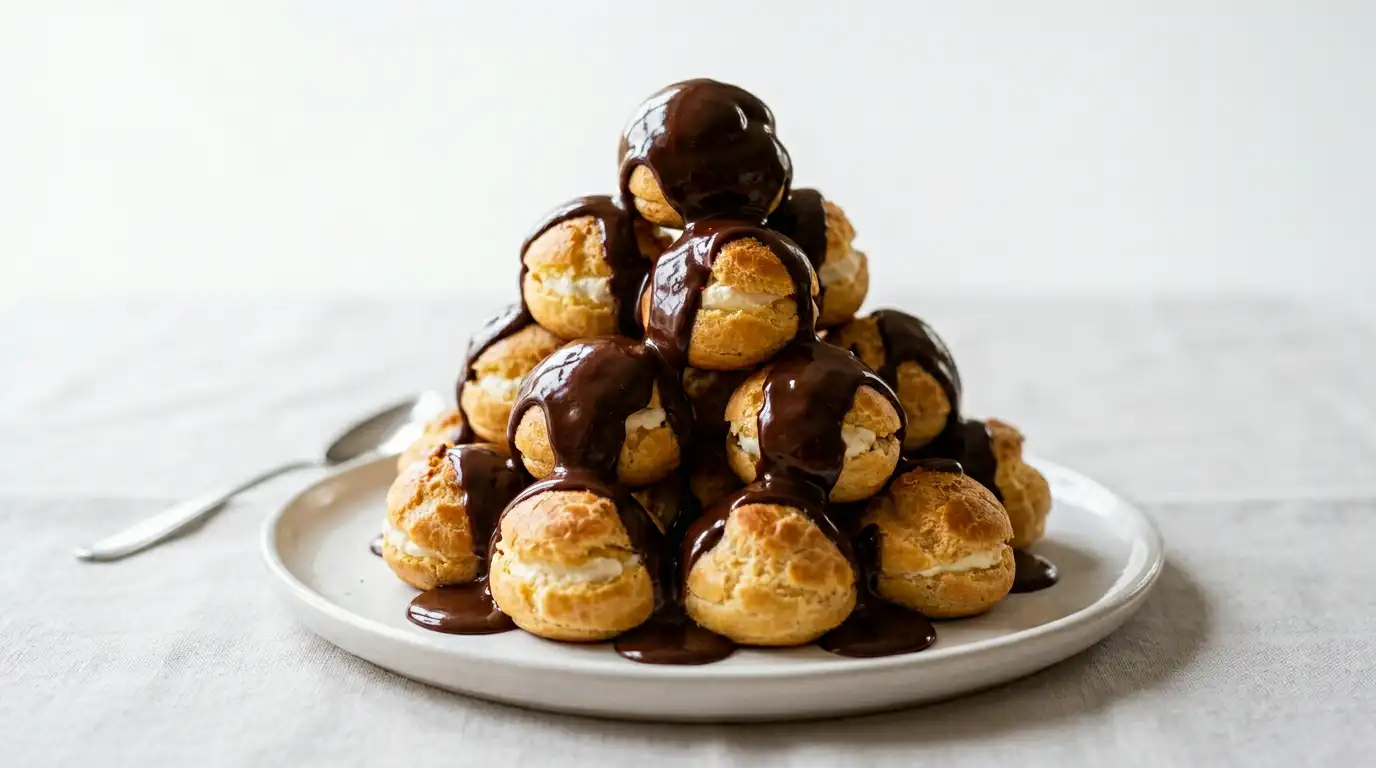
Mary Berry profiteroles are light, hollow choux pastry shells with a crisp golden exterior and a soft, almost hollow centre, filled with softly whipped cream and finished with a rich, glossy dark chocolate sauce that sets beautifully as it cools. Each bite delivers a contrast of textures, the delicate crunch of the pastry giving way to cold, lightly sweetened cream beneath a coating of deep, bittersweet chocolate.
What makes this version stand out is the reliability of the method. Choux pastry has a reputation for being difficult, but when the ratios are precise and the steps are followed in order, it performs consistently every time. These profiteroles work just as well for a casual family dinner as they do for a dinner party centrepiece. From start to finish, they are ready in around 1 hour 15 minutes.
Ingredients
- 75g plain flour
- 60g unsalted butter, cut into small cubes
- 150ml cold water
- 2 large eggs, beaten
- pinch of fine salt
- 300ml double cream, cold
- 1 tsp icing sugar, sifted
- 1 tsp vanilla extract
- 150g dark chocolate (70% cocoa), roughly chopped
- 150ml double cream
- 1 tbsp golden syrup
- 20g unsalted butter
How to Make Mary Berry Profiteroles
Prepare the oven and trays
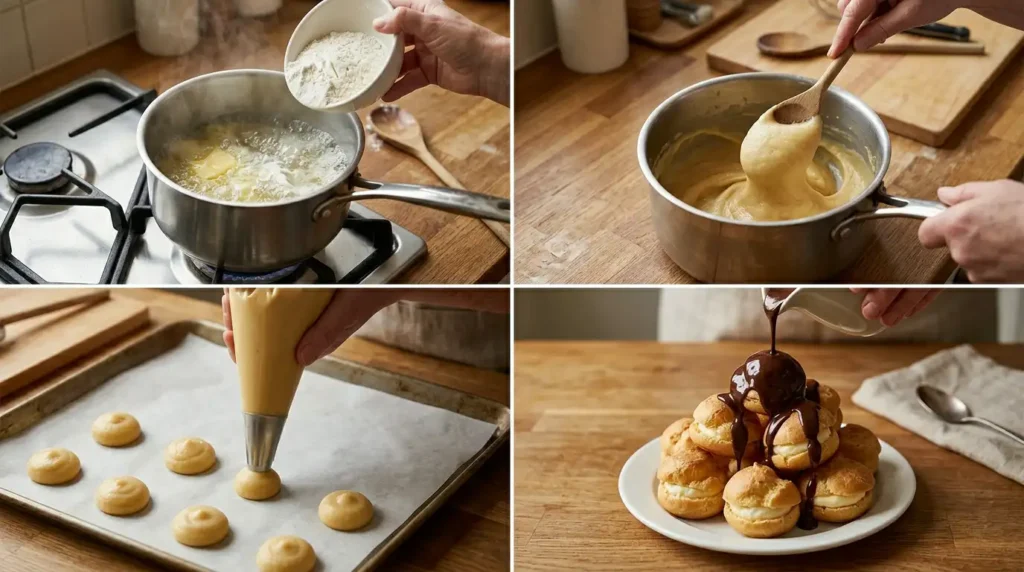
Heat the oven to 200°C (180°C fan, Gas 6). Line two large baking trays with non-stick baking paper. Lightly mist the paper with water from a spray bottle, as the steam created during baking helps the choux shells to rise and hollow out properly.
Make the choux paste
Place the butter and water in a medium saucepan over a medium heat. As soon as the butter has fully melted and the liquid reaches a rolling boil, take the pan off the heat immediately. Leaving it on the heat any longer can cause the water to evaporate and throw off the balance of the dough. Add the flour and salt all at once, then beat vigorously with a wooden spoon until the mixture comes together and pulls cleanly away from the sides of the pan, forming a smooth, compact ball. Leave to cool for 8 minutes.
Incorporate the eggs
Transfer the cooled dough to a large bowl. Add the beaten eggs a little at a time, beating well after each addition. The mixture should be thick, smooth, and glossy, and drop reluctantly from the spoon when held upright. Adding the eggs too quickly to hot paste can cause them to scramble, so the cooling period is important. The finished paste will hold its shape when piped.
Pipe the profiteroles
Spoon the choux paste into a piping bag fitted with a 1cm plain round nozzle. Pipe 20 to 22 small mounds onto the prepared trays, spacing them about 4cm apart to allow room for expansion. Each mound should be roughly 3cm in diameter. Dampen a finger and press down any peaked tips so the shells bake evenly without burning at the point.
Bake until golden and firm
Bake for 22 to 25 minutes until the shells are a deep golden brown and feel completely firm when gently tapped on the base. Do not open the oven door in the first 18 minutes, as the drop in temperature will cause the shells to collapse. Once baked, pierce the base of each shell with a small skewer or the tip of a sharp knife to allow the steam to escape, then return to the oven for 3 minutes. Transfer to a wire rack and leave to cool completely.
Prepare the cream filling
Pour the cold double cream into a chilled bowl. Add the icing sugar and vanilla extract, then whisk to soft, billowy peaks. The cream should hold its shape without being grainy or overworked. Spoon into a piping bag fitted with a small plain nozzle. Pipe the cream into each shell through the hole in the base until you feel the shell become slightly heavier in your hand.
Make the chocolate sauce
Place the chopped chocolate, double cream, golden syrup, and butter in a small saucepan over a low heat. Stir gently and continuously until the chocolate has fully melted and the sauce is smooth, shiny, and pourable. The golden syrup gives the sauce a subtle gloss and prevents it from setting too hard. Remove from the heat and leave to cool for 5 minutes before using.
Assemble and serve
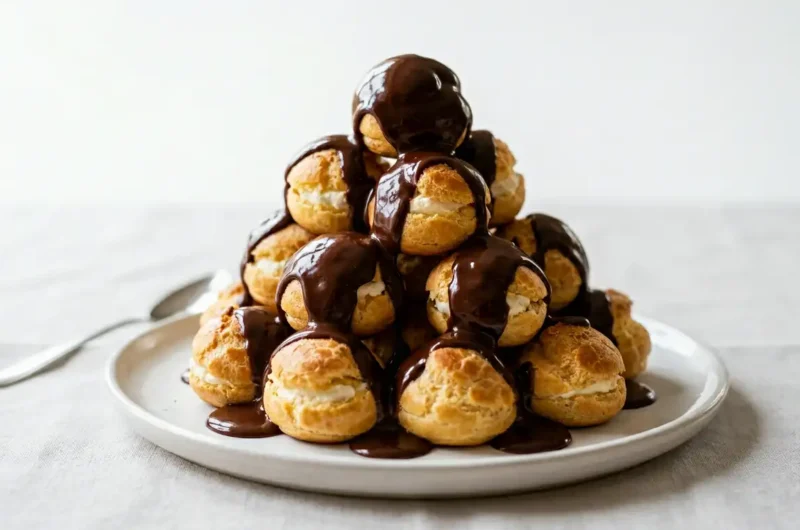
Arrange the filled profiteroles in a neat pyramid on a serving plate or in individual bowls. Pour the warm chocolate sauce generously over the top just before serving, allowing it to coat and drape down between the shells. The contrast between the warm sauce and the cold cream filling is a key part of the finished dish, so serve without delay once the sauce is added.
Tips for the Best Mary Berry Profiteroles
01 Why did my profiterole shells collapse after coming out of the oven?
Collapsed shells are almost always caused by underbaking or opening the oven door too early. The shells need to be deep golden all over and feel completely firm when tapped. If there is any softness left in the crust, they will deflate as they cool. Always pierce the base and return them to the oven for those final 3 minutes to drive out the internal steam.
02 Why is my choux paste too runny to pipe into shape?
The paste has most likely received too much egg. Each addition of egg should be beaten in thoroughly before adding more, and the final quantity may not always be needed if the dough already has the correct dropping consistency. Test the paste by holding a spoonful over the bowl; it should fall slowly rather than pour off the spoon.
03 How do I stop the cream filling from making the shells go soggy?
Fill the profiteroles as close to serving time as possible, no more than an hour ahead if they are going to be kept at room temperature. The whipped cream introduces moisture that softens the pastry over time. If preparing in advance, store the unfilled shells and the whipped cream separately, then assemble just before serving.
04 Why has my chocolate sauce turned grainy or split?
This happens when the heat is too high or the mixture is stirred too fast. Keep the heat low and stir gently in one direction. If the sauce looks grainy or oily, remove it from the heat and stir in a tablespoon of warm cream very slowly to bring it back together.
05 My profiteroles came out flat rather than round and puffed. What went wrong?
Flat shells usually mean the paste was too warm when the eggs were added, causing them to cook slightly before being fully incorporated. Always allow the cooked dough to cool for at least 8 minutes before adding the eggs, and beat thoroughly at each stage. The finished paste should be visibly glossy and hold a soft peak.
Serving Suggestions
Serve the profiteroles immediately after pouring the chocolate sauce, stacking them loosely in a shallow bowl so the sauce pools around the base of each shell.
Add a small scoop of good-quality vanilla ice cream alongside for a dinner party dessert, placed on the plate beside the profiterole stack rather than underneath.
Dust lightly with icing sugar just before the chocolate sauce goes on for a visual finish that adds a faint sweetness without overpowering the chocolate.
Pair with a strong, lightly sweetened espresso or a cup of Darjeeling tea when serving at an afternoon gathering, balancing the richness of the cream and chocolate.
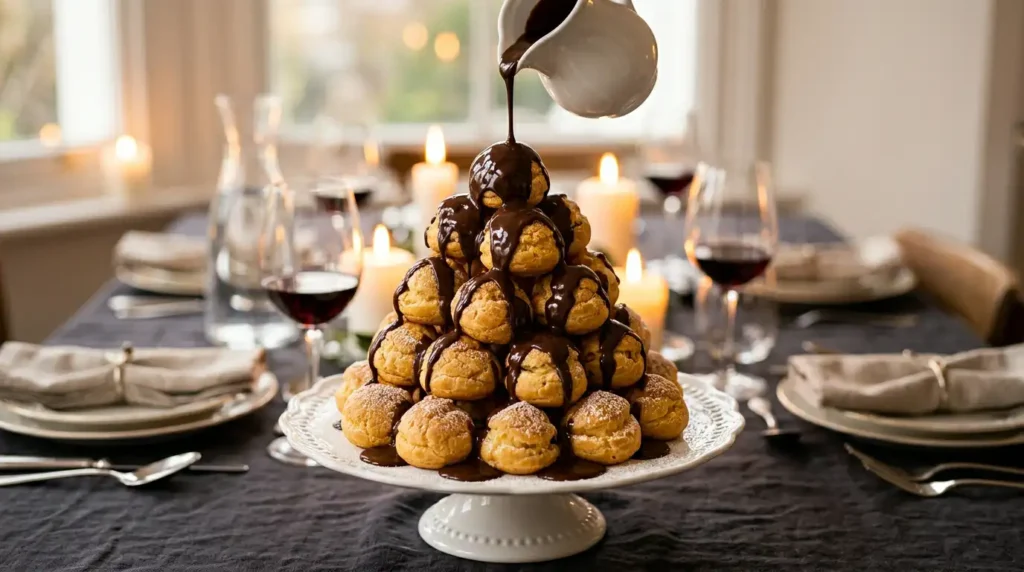
Arrange in a tall pyramid on a cake stand for a buffet or celebration table centrepiece, and drizzle the chocolate sauce at the table so guests see the sauce fall live.
Storage
Room Temperature
Unfilled choux shells can be stored in an airtight container at room temperature for up to one day without losing their crispness.
Refrigerator
Once filled, keep the profiteroles in the fridge in a loosely covered container for up to 2 days. The pastry will soften slightly. Allow them to sit at room temperature for 10 minutes before serving to take the chill off the cream.
Freezing
Freeze unfilled baked shells on a tray until solid, then transfer to a sealed freezer bag for up to one month. Defrost at room temperature for 30 minutes, then refresh in an oven at 180°C for 5 minutes before cooling and filling.
Nutrition
FAQs
01 Can I make the choux pastry shells ahead of time?
02 Can I use milk chocolate instead of dark chocolate for the sauce?
03 Can I fill profiteroles with something other than whipped cream?
04 Can I double this recipe to make more profiteroles for a large group?
05 Is a piping bag essential or can I use a spoon to shape the choux?
Conclusion
Mary Berry profiteroles are one of those recipes that looks more complicated than it actually is. Once the choux paste is mastered, the rest follows naturally. The recipe here makes 20 to 22 profiteroles, which is a generous amount for 4 to 6 people as a dessert. The shells are light and golden, the cream filling is cold and softly whipped, and the chocolate sauce is dark, glossy, and just thick enough to coat each shell without becoming heavy. Together, the three components produce a dessert that has real presence on the table with relatively little effort.
Give this recipe a go and share your results in the comments below. If you had any questions about the choux pastry or the chocolate sauce, leave them there too and we will be happy to help. If you enjoyed making these Mary Berry profiteroles, you might also like the Mary Berry Ginger Sponge Pudding Recipe, another reliable and deeply satisfying dessert from the same trusted approach to home baking.
Mary Berry Profiteroles Recipe
Course: DessertCuisine: FrenchDifficulty: Medium20
servings25
minutes30
minutes210
kcal1
hour15
minutesLight, hollow choux pastry shells with a crisp golden exterior, filled with softly whipped vanilla cream and finished with a rich, glossy dark chocolate sauce. Reliable, beginner-friendly, and impressive enough for a dinner party centrepiece.
Ingredients
75g plain flour
60g unsalted butter, cut into small cubes
150ml cold water
2 large eggs, beaten
pinch of fine salt
300ml double cream, cold
1 tsp icing sugar, sifted
1 tsp vanilla extract
150g dark chocolate (70% cocoa), roughly chopped
150ml double cream
1 tbsp golden syrup
20g unsalted butter
Instructions
- Heat the oven to 200°C (180°C fan, Gas 6). Line two large baking trays with non-stick baking paper and lightly mist the paper with water from a spray bottle.
- Place the butter and water in a medium saucepan over a medium heat. As soon as the butter has fully melted and the liquid reaches a rolling boil, take the pan off the heat. Add the flour and salt all at once and beat vigorously with a wooden spoon until the mixture forms a smooth, compact ball. Leave to cool for 8 minutes.
- Transfer the cooled dough to a large bowl. Add the beaten eggs a little at a time, beating well after each addition, until the paste is thick, smooth, and glossy and drops reluctantly from the spoon.
- Spoon the choux paste into a piping bag fitted with a 1cm plain round nozzle. Pipe 20 to 22 small mounds onto the prepared trays, spacing them about 4cm apart. Dampen a finger and press down any peaked tips.
- Bake for 22 to 25 minutes until deep golden brown and completely firm when tapped on the base. Do not open the oven door in the first 18 minutes. Pierce the base of each shell with a skewer, return to the oven for 3 minutes, then transfer to a wire rack to cool completely.
- Pour the cold double cream into a chilled bowl. Add the icing sugar and vanilla extract and whisk to soft peaks. Spoon into a piping bag with a small plain nozzle and pipe into each shell through the hole in the base.
- Place the chopped chocolate, double cream, golden syrup, and butter in a small saucepan over a low heat. Stir gently until smooth and glossy. Remove from the heat and leave to cool for 5 minutes.
- Arrange the filled profiteroles on a serving plate or in bowls and pour the warm chocolate sauce generously over the top just before serving.
Notes
- Always let the choux paste cool for at least 8 minutes before adding eggs to prevent them from scrambling.
- Do not open the oven door during the first 18 minutes of baking or the shells will collapse.
- Pierce the base of each shell immediately after baking to release steam and keep the pastry crisp.
- Fill the profiteroles as close to serving time as possible to prevent the shells from softening.
- The chocolate sauce can be made ahead and gently reheated over a low heat before serving.